Website Builder > Essentials
Custom Components
Learn how to add custom components in the Next.js starter kit with Website Builder.
- how to add custom components to your Website Builder
In this tutorial, we explain how to create, register and use custom components in this Website Builder project.
- Step 1: Add a React component file
- Step 2: Register the component
- Step 3: Ensure the group matches the one registered
- Step 4: Open the editor to verify the component appears in the chosen group
Overview
- Custom components live in the
src/editorComponentsfolder and are provided to the renderer viaeditorComponentsexported fromsrc/editorComponents/index.tsx. - The page renderer (
src/components/DocumentRenderer.tsx) passeseditorComponentstoDocumentRendererfrom@webiny/website-builder-nextjs. - Component groups (used in the editor UI) are registered in
src/contentSdk/initializeContentSdk.tsusingregisterComponentGroup.
Files to Inspect
src/editorComponents/index.tsx— the central list of editor components and input definitionssrc/components/DocumentRenderer.tsx— how components are provided to the renderersrc/contentSdk/initializeContentSdk.ts— where component groups are registered
Step-by-Step: Create a New Custom Component
Step 1: Add a React Component File
Add a React component file under src/editorComponents (or a subfolder). In this tutorial we will create CalloutBox component.
- Prefer exporting a named component (e.g.
export const CalloutBox = () => { ... }). - Keep the component as a standard React functional component.
Example minimal component:
Step 2: Register the Component
Define editor inputs and register the component in src/editorComponents/index.tsx.
- Use
createComponentfrom@webiny/website-builder-nextjsto register the component withname,label,groupandinputs. - Use input helpers such as
createTextInput,createLongTextInput,createLexicalInput,createFileInput,createSelectInput,createSlotInput.
Example registration snippet (add to src/editorComponents/index.tsx):
Notes:
- The
nameproperty defines the unique editor identifier (used by the editor to save/load the block). - The
groupshould match a component group registered insrc/contentSdk/initializeContentSdk(e.g.,custom,basic).
How inputs map to component props
- When the editor renders the page, the
DocumentRendererwill render your component and pass the block data as props. - Typical convention: input names map to prop names. For example,
titlebecomesprops.titleinside your component. - For slot inputs (
createSlotInput) the renderer will pass an array of nested blocks which you should render usingchildrenor a dedicated renderer.
Step 3: Ensure the Group Matches the One Registered
- Component groups (editor categories) are registered in
src/contentSdk/initializeContentSdk.tswithregisterComponentGroup. - Pick an existing group (
basic,sample) or add a new one ininitializeContentSdk.ts.
In this tutorial, we used an existing group, but if you ned to create a new one, for example, a new Demo Group add the following to initializeContentSdk.ts:
Note: the order in which the Component groups show in the Website builder depends on the order in which they were added to the file above.
- Keep components presentation-focused; prefer receiving plain data from inputs rather than coupling to editor APIs inside the component.
- For rich text, prefer
createLexicalInputwhere content is saved as Lexical nodes and will be rendered byDocumentRenderer. - Use
createSlotInputto allow nesting arbitrary content inside your block. - Keep components SSR-friendly. Use client-only code (like browser-only libs) inside a child component or guarded by dynamic import to avoid SSR issues.
Step 4: Open the Editor to Verify the Component Appears in the Chosen Group and That It Is Functional.
- Run the site and open a new Page in the editor to verify the component appears in the chosen group.
- Drag and drop the new component in the Page to validate it is functional.
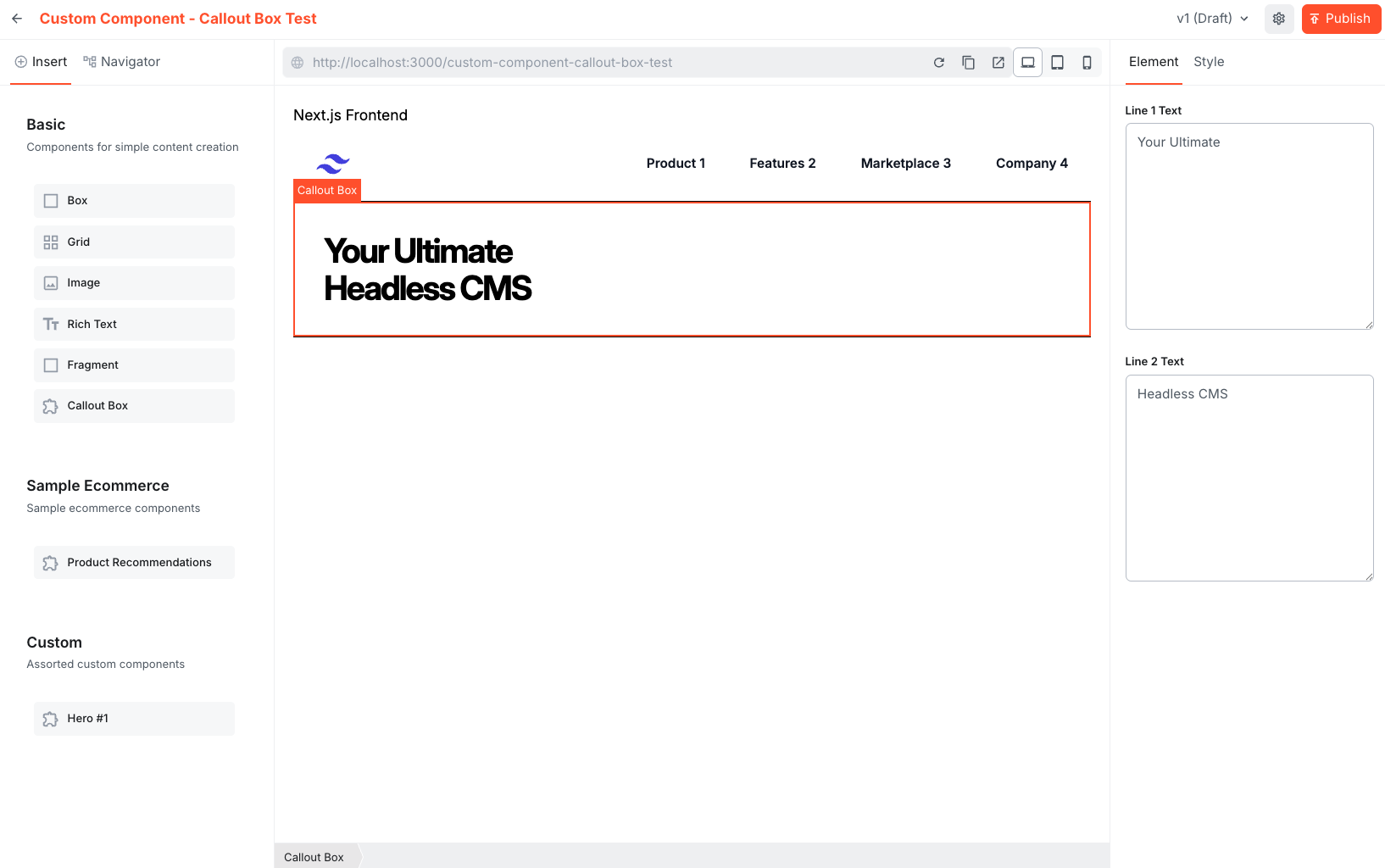 Callout Box Custom Component